You can have daily headlines from
FedSmith.com delivered right to your desktop each business morning.
The service is free and you don't get junk e-mail as the price of
your subscription. Just
visit our newsletter
page to sign up!
The number of Thrift Savings Plan investors moving into the lifecycle
funds is continuing to grow.
As of July 31st, 606.828 people are investing in a lifecycle fund. As of
December 31, 2008, 584,468 participants were investing in an L fund.
But it is somewhat surprising to look a little further. The concept behind
the L funds is that a person can put money into a fund based on a projected
retirement date. It makes it easier to invest your retirement funds in one place
and the allocation becomes more conservative as you near retirement age.
In reality, the number of TSP participants with their entire account balance
invested in one lifecycle fund is fairly small. 4% of FERS participants have
their money in one fund. For CSRS participants, 3% of participants have all of
their TSP money invested in one lifecycle fund.
Currently, Thrift Savings Plan Investors who are under the FERS retirement
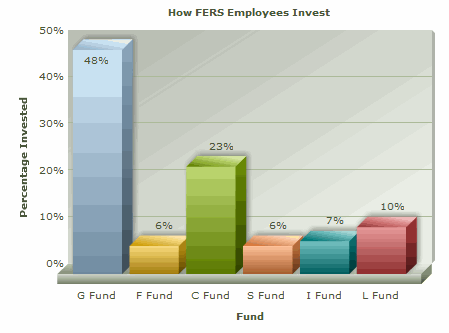
system have 10% of their money in an L fund. The biggest chunk, 48%, is in the G
fund and 23% is in the C fund.
Here is a chart depicting how TSP investors under the FERS retirement system
have elected to invest their retirement funds:

Thrift Savings Plan investors under the CSRS retirement system have 8% of
their money in an L fund and 56% of their money in the G fund. 21% is in the C
fund. CSRS employees are generally closer to retirement (or more likely to be
retired) than those under FERS as the CSRS plan was in place before being
displaced by FERS.
Here is a depiction of how TSP investors under the CSRS retirement system
have allocated their retirement investments:
In effect, TSP investors are using the L fund as they would use one of the
TSP funds--apparently as a way of diversifying their investments rather than
using it as the primary source of investing for their retirement future.While TSP investors are now using the L funds more, they have obviously not
bought into the concept of the lifecycle funds as a way to invest all of their
retirement funds using a pre-determined allocation feature. That probably
indicates a lack of trust in the concept as investors appear to want to make
their own investment decisions on how to allocate their money rather than
relying on the formula used for the different funds.
© 2009 FedSmith Inc. All rights reserved. This article may not be reproduced without express written consent of FedSmith Inc.
Click here too Add a Comment about this Article
|