The overbought / oversold indicator appears to be making a longer term peak.


Chart provided courtesy of www.decisionpoint.com
The new AAII Investor Sentiment Survey results are in:
58% Bullish
18% Bearish
I think I have bored you with my pullback opinion enough lately. Unless something significant happens Thursday, I will give you a break and be back with you Monday morning.
That's all for today. Currently 100% G fund. Thanks for reading.
Have questions? Visit our message board for answers.
Would you like to be on our
email alert
list?
We will send you an email when there is a change to our asset allocation
or market outlook. Input your email address in the form on the top
right of any page and you're in. Your email address will never be
given out.
Read our
privacy policy.
By signing up you agree to the TSP Talk
Terms of
Service. More details below **.
Are you bullish or bearish?
Join the Weekly Sentiment Survey.
Like
what you're reading? Tell
a Friend
about us.
Prior Day's Market Comments (see archives on left for earlier comments)
Six straight days of higher lows.Because of a late Little League tournament Tuesday night, this will be very brief.
We are in short term, very tight rising trend as we've had 6 consecutive higher lows for the S&P 500, and 1229 is the current support area I am watching.
Recent S&P 500 Lows
| Date | Low |
| 26-Jul-05 | 1,229.03 |
| 25-Jul-05 | 1,228.15 |
| 22-Jul-05 | 1,226.15 |
| 21-Jul-05 | 1,224.70 |
| 20-Jul-05 | 1,222.91 |
| 19-Jul-05 | 1,221.13 |
No immediate signs of danger in the S&P 500 chart but the indicators tell another story. The battle continues and the bulls are currently winning the war.
Here is this week's TSP Talk Sentiment Survey. Thanks for participating.
| For the week of 7/25 - 7/29, I am... | |||
| Votes | Ratio | ||
| Bullish (up) |
 |
80 | 47% |
| Bearish (down) |
 |
58 | 34% |
| Neutral |
 |
32 | 19% |
| 170 votes total | |||
That's all for today. Currently 100% G fund. Thanks for reading.
7/26/2005
The strength in oil stocks is
not a good sign for broader market.
The weakness yesterday really didn't do much damage from a technical
standpoint. The S&P 500 actually made a higher high and a
higher lower, meaning the uptrend is intact. Things are still
looking a little frothy to me and how the market handles a little
pullback could set the stage for either another quick buying
opportunity, or an extended leg down. I think we could get our
answer in the next week or two.
The last several days in July tend to be better than average but
historically August and September are tough to get through without
some damage being done.

Chart provided courtesy of
www.sentimentrader.com
On to oil. In the past 22 years, there have been four other times when the six-month return in the Oil Index has outdone the Bank Index by 20% or more for at least 30 consecutive days, as we see today. If history repeats itself then we should see some stress on the broader market. Let’s briefly discuss those four occurrences.
The first time this disparity between Oils and Banks hit such a long streak was August 11, 1987. The streak hit 30 days just as the broader market was topping out. It jerked around for a couple of weeks, but then began the slide that would eventually turn into the October crash.
The next occurrence was on January 11, 1990. The S&P 500 had already topped out but it continued to decline quite stiffly for the rest of the month, and then didn’t really go much of anywhere until it bottomed in late April.
Next we come to a time later that same year, August 30, 1990. This was only a bit after Saddam Hussein had invaded Kuwait and the U.S. moved troops into Saudi Arabia. The S&P declined for the rest of the month before experiencing some wild volatility – and eventually a bottom – in October.
The last occurrence, prior to the current one, wasn’t seen for another 9 years, on September 3, 1999. That was the high close for nearly the next two months, as once again the S&P went through a month-long decline, then heavy volatility – and another bottom – in October.
Across the four instances, the
future 30-day return after these “Oil over Bank” streaks was -4.5%
in the S&P 500, with all four showing consistent negative returns.
After 60 days, three of the four were still negative, and the
average return dropped to -6.5%, but that was mostly due to the
dramatic decline in 1987.
The longer we wait for this pullback the more susceptible I believe
the market is to a crash-like sell off. Probably not of the
1987 magnitude but it could be swift and blindside those being too
complacent. I would prefer it that way myself because I am
eager to start making money again. I will not chase the market
at this point so the sooner we sell off, the better.
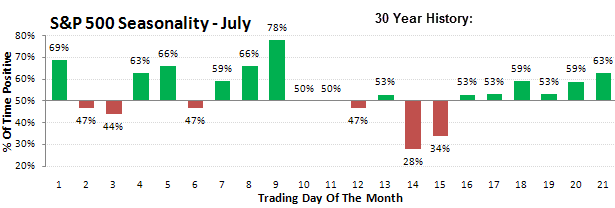
Chart provided courtesy of
www.sentimentrader.com
-------------------------------------------------------------------------------------------------------------------
**
By joining our email alert list you will
receive an email each time I initiate a transfer or change my market
outlook. You may also receive an email each Monday morning
reminding you that our comments are updated daily. I will always
send out these emails prior to making the transfer myself but I can not
guarantee you will receive it in time to make a transfer yourself.
By joining you understand that this is what I am doing in my own account
and if you decide to follow our transfers in your
own account, you do so at your own risk. There is always a
possibility for a loss in your account. These transfers could come
very often and you may have to act quickly to make the deadline.
Please consider your investment strategy before taking any advice or
making any transactions. By reading the contents of TSP Talk.com
and accepting the email alerts, you must agree to the
Terms of
Service. Thank you.
Tom