|
| Today's Comments (Short Term Outlook) |
|
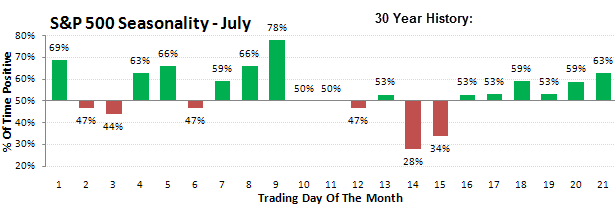
New week, same quandary Stocks were mixed again on Friday, as the Dow and S&P 500 closed modestly lower, while the small caps did well, and the I-fund managed a small gain. Bonds were also up slightly. We started last week with a sharp decline, believing we could be seeing the start of the next intermediate-term move. But by the end of the week most indices gained most or all of their earlier declines, and we were left with the same question; which way is this market going to break from this recent trading range? The S&P is back above the 20 and 50-day EMA's, and above the 200-day simple moving average (not shown but it is 894), but is remains below the 200-day EMA. It is a tight bunch of moving averages and trendlines and we are due for a sharp move, unfortunately, I have to claim ignorance on knowing which direction that may be. But now that we are hitting the summer doldrums, who knows how long this choppiness will last?
"Let's try to find any time since the survey's inception in the late
1980's when the percentage of bulls dropped to a three-month low, but
the S&P 500 had rallied at least 12% over those three months. Uhh, we
can't. It's never happened. How
about after a 10% rally? Then we get only two precedents (using
Friday-to-Friday closing prices). Those priors occurred on 04/26/91 and
03/07/97. Over the following month, the S&P lost -0.4% and -5.9%,
respectively. To get
more instances, let's drop the requirement to a three-month rally of 5%
or more in the S&P. In that case, 26 weeks qualify for the study. And
one month later, the S&P was positive 54% of the time with an average
return of +0.5%, and an average drawdown (maximum loss) that almost
exactly equaled the average maximum gain, around 2.1%. That's not
horrible, but it's certainly not the major buy signal that "wall of
worry" proponents would probably suggest. Over
the past decade, we've seen this happen 11 times. During the next
month, the S&P managed to rally only 3 times, and its average return was
-1.5%. Lest you think this was purely confined to the bear markets, the
last occurrence was on 08/05/05, fully in the midst of the last great
bull run. Over the next three months, the S&P lost close to -4%. The
time before that was 12/31/04, right before the S&P took another
multi-month tumble. The time before that was 01/30/04, after which the
S&P topped out a few weeks later and tripped into May. During
the last bear market, we saw this occur on 06/08/01 and 01/11/02. The
S&P lost more than -4% over the next month both times." |